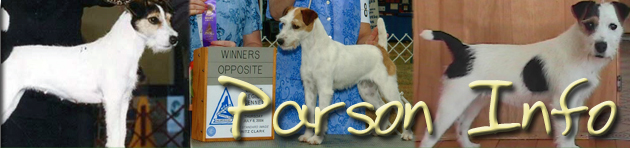
On April 1, 2003, the AKC changed the name of the breed from Jack Russell Terrier to Parson Russell Terrier. This is to distinguish between the correct, longer legged dog and the shorter legged dog, often referred to as the pudding or shortie.
The Parson Russell
Terrier was developed in the South of England in the 1800's as a white
terrier to work European Red Fox both above and below ground. The terrier
was named for the Reverend John Russell, whose terriers trailed hounds
and bolted foxes from dens so the hunt could ride on.
To function as a working terrier, he must possess certain characteristics:
a ready attitude, alert and confident, balanced in height and length,
medium in size and bone, suggesting strength and endurance. Important
to breed type is a natural appearance; a harsh, weatherproof coat with
a compact construction and clean silhouette. The coat is broken or smooth. He has a small, flexible chest to enable him to pursue his quarry
underground and sufficient length of leg to follow the hounds. Old scars
and injuries, the result of honourable work or accident, should not be
allowed to prejudice a terrier's chance in the show ring, unless it interferes
with movement or utility for work or for breeding.
Size: Both sexes are properly balanced between 12" and 14" at the withers. The ideal height of a mature dog is 14" at the withers, and bitches 13". Terriers whose heights measure either slightly larger or smaller than the ideal are not to be
penalised in the show ring provided other points of their conformation,
especially balance and chest span, are consistent with the breed standard. The weight of the terrier in hard working condition is usually between 13 - 17 pounds.
Proportion: Balance is the keystone of the terrier's anatomy. The chief points of consideration are the relative proportions of skull and
foreface, head and frame, height at the withers and length of body. The height at the withers is slightly greater than the distance from withers to tail, i.e. by possibly 1 to 1.5 inches on a 14 inch dog. The measurement will vary according to height, the ratio of height to back being approximately 6:5.
Substance: The terrier is of medium bone, not too heavy as to appear coarse or so light as to appear racy. The conformation of the whole frame is indicative of strength and endurance.
Head: Strong
and in good proportion to the rest of the body, so the appearance of balance
is maintained.
Expression: Keen, direct, full of life and intelligence.
Eyes: Almond shaped, dark in colour, moderate in size, not protruding. Dark rims are desirable.
Ears: Button ear. Small 'V' shaped drop ears of moderate thickness carried
forward, close to the head with the tip so as to cover the orifice and
pointing toward the eye. Fold is level with the top of the skull or slightly
above. When alert, ear tips do not extend below the corner of the eye.
Skull: Flat and fairly broad between the ears, narrowing slightly
to the eyes. The stop is well defined but not prominent.
Muzzle: Length from nose to stop is slightly shorter than the distance
from stop to occiput.
Jaws: Upper and lower are of fair and punishing strength.
Nose: Must be black and fully pigmented.
Bite: Teeth are large with complete dentition in perfect scissors bite,
i.e., upper teeth closely overlapping the lower teeth and teeth set square to the jaws.
Neck: Clean
and muscular, moderately arched, of fair length, gradually widening so
as to blend well into the shoulder.
Topline: Strong, straight, and level in motion, the loin slightly
arched.
Body: In overall length to height proportion, the dog appears approximately square and balanced.
The back is neither short nor long. The back gives no appearance of slackness
but is laterally flexible, so that he may turn around in an earth. Tuck-up is moderate.
Chest: Narrow and of moderate depth, giving an athletic rather
than heavily chested appearance; must be flexible and compressible. The
ribs are fairly well sprung, oval rather than round not extending past
the level of the elbow.
Tail: Set high, strong, carried gaily but not over the back or curled. Docked
so the tip is approximately level to the skull, providing a good handhold.
Shoulder: Long and sloping, well laid back, cleanly cut at the withers. Point of
shoulder sits in a plane behind the point of the prosternum. The shoulder
blade and upper arm are of approximately the same length; forelimbs are
placed well under the dog.
Elbows: hang perpendicular to the body, working
free of the sides. Legs are strong and straight with good bone. Joints
turn neither in nor out.
Pasterns: firm and nearly straight.
Feet: Round, catlike, very compact, the pads thick and tough, the toes moderately
arched, pointing forward, turned neither in nor out.
Strong and muscular,
smoothly molded, with good angulation and bend of stifle. Hocks near
the ground, parallel, and driving in action. Feet as in front.
Smooth: Double-coated. Coarse
and weatherproof. Flat but hard, dense and abundant, belly and undersides of thighs are not bare.
Broken: Double coated. Coarse and weatherproof. Short,
dense undercoat with a harsh, straight, tight jacket, which lies flat
and close to the body and legs. There is a clear outline with only a hint of eyebrows and beard. Belly and undersides of thighs are not bare. Coat does not show a strong tendency to
curl or wave. No sculptured furnishings. The terrier is shown in
natural appearance not excessively groomed. Sculpturing is to be severely
penalised.
White, white with
black or tan markings, or a combination of these, tri-color. Colours clear. Grizzle is acceptable and should not be confused with brindle.
Movement or action
is the crucial test of conformation. The terrier's movement is free, lively,
well co-ordinated, with straight action in front and behind. There should
be ample reach and drive with a good length of stride.
Bold and friendly.
Athletic and clever. At work he is a game hunter, tenacious and courageous. At home he is playful, exuberant and overwhelmingly affectionate. He is an independent
and energetic terrier and requires his due portion of attention. He should not be quarrelsome. Shyness should not
be confused with submissiveness. Submissiveness is not a fault. Sparring is not acceptable.
To measure a terrier's
chest, span from behind, raising only the front feet from the ground and
compress gently. Directly behind the elbows is the smaller, firm part
of the chest. The central part is usually larger but should feel rather
elastic. Span with the hands tightly behind the elbows on the forward
portion of the chest. The chest should be easily spanned by average sized
hands. Thumbs should meet under the chest. This is a significant factor
and a critical part of the judging process. The dog cannot be correctly
judged without this procedure.
Height under 12" or over 15". Prick ears, liver nose. Four or more missing teeth. Overshot, undershot or wry mouth. Brindle markings. Overt aggression towards other dogs or humans.